Edathumpadickal Family-
Through the Historical Evidences and Facts...
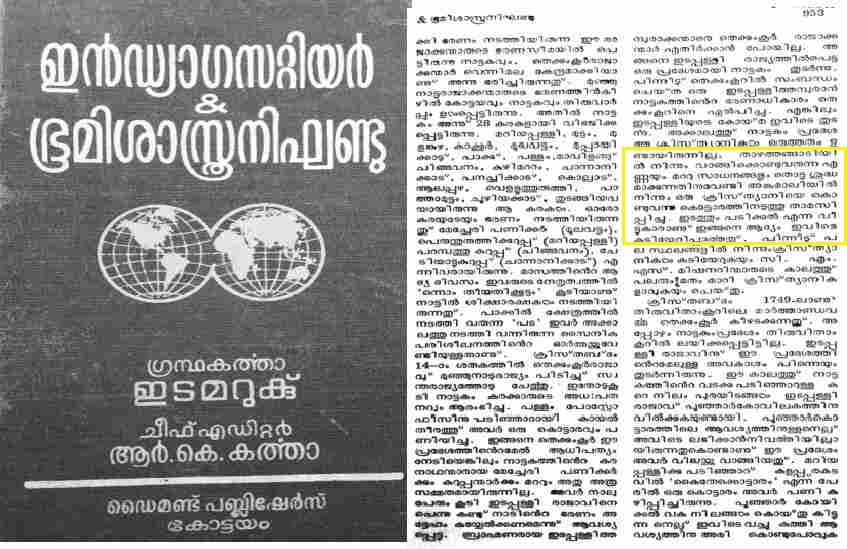
The book 'India Gazateer And Bhoomisasthra Nighandu' by Sri. Joseph Edamaruk
Joseph Edamaruku (7 September 1934 – 29 June 2006), popularly identified by his surname Edamaruku, was a journalist and rationalist from Kerala. He was the Delhi Bureau chief of the Malayalam magazine Keralasabdam for more than twenty years, and the founder-editor of Therali, a rationalist periodical in Malayalam. He was president of the Indian Rationalist Association from 1995 to 2005.
The India Gazetteer and Bhoomisasthra Nighandu (ഇന്ത്യ ഗസറ്റിയര് ആന്ഡ് ഭൂമി ശാസ്ത്ര നിഘണ്ടു) by Joseph Edmaruk is a detailed description of the social-political and geographical characteristics of ancient South India. The book spreads light on to the South Indian social situations and cultural systems followed in the ancient era.
In page 953 of the book, the author describes the historical facts about Kottayam and nearby places such as Nattakam and Thiruvarppu. According to the author Nattakam was divided into 28 Karas(provinces) including Pallom, under the ruling of Munjunadu Dynasty. In 14th century Thekkumcore Raja conquerred and annexed Munjunadu to Thekkumcore Kingdom. Thekkumcore Raja built a Palace in Pallom. During that period, it was a custom amongst the Royal Families that if a Nazrani, ie., traditional Syrian Christian touches the things brought from outside for palace and their temples, the same will become pure and can be consumed by higher caste like Kshatriyas. But there were no Christians lived in Nattakam area until that period. For the purpose of purifying oil and other items bought from Thazhathangady, the Thekkumcore Raja brought a christian who migrated to Kottayam from Angamali. The author also mentions that Edathumpadickal is the first family migrated and settled in Nattakom-Pallom area. (Courtesy to the author and publisher)
The book 'Thekkumkur Charithravum Puravruthavum' by Prof. N.E. Kesavan Namboothiri
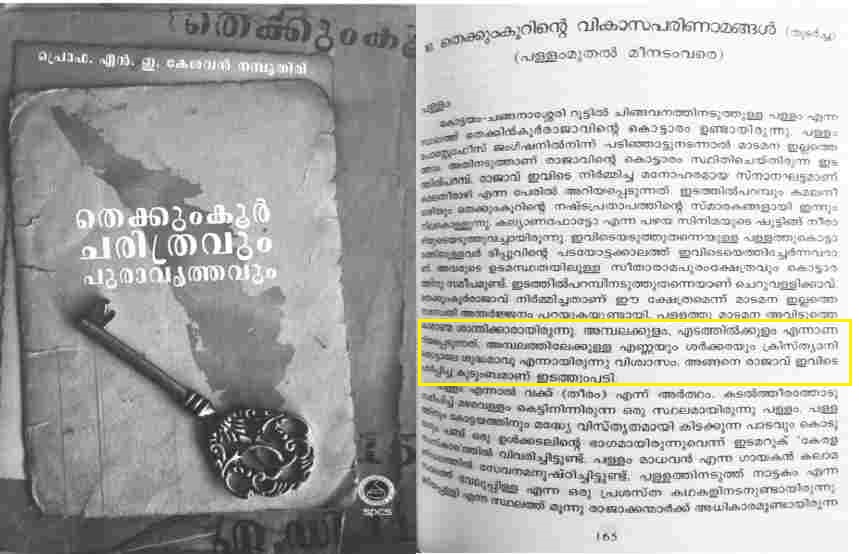
Professor N. E. Kesavan Namboothiri is a noted Historian and Writer who serves as Professor in NSS Hindu College, Changanassery. The book 'Thekkumkur Charithravum Puravruthavum (തെക്കും കൂര് ചരിത്രവും പുരാ വൃത്തവും)' is a historical journey through the ruling period of Thekkumkur Dynasty in the present Kottayam and nearby places. The author has done a deep research on the subject and described it in a detailed writng. The book becomes very relevant as the historical remainings of the Thekkumcore Dynasty and its headquarters were completely destroyed by Ramayyan Dalawa, minister of Marthanda Varma while Travancore conquerred Thekkumcore in AD1749.
The author of the book describes the relevant incidents and facts of the Thekkumcore ruling period and the remainings of the above mentioned period in th present time. The reader of the book would experience a journey through the Thekkumcore period as the author connects the described facts in the book with the still existing landmarks and places. In the page 165 of the book, author says the belief that oil and jaggery bought for the Temple to be purified by the touch of a Christian and hence the King made a family settled there called Edathumpadickal. (Courtesy to the author and publisher)
The book 'Madhya Kerala Charithra Veekshanam' by Sri. Mangattu John Abraham
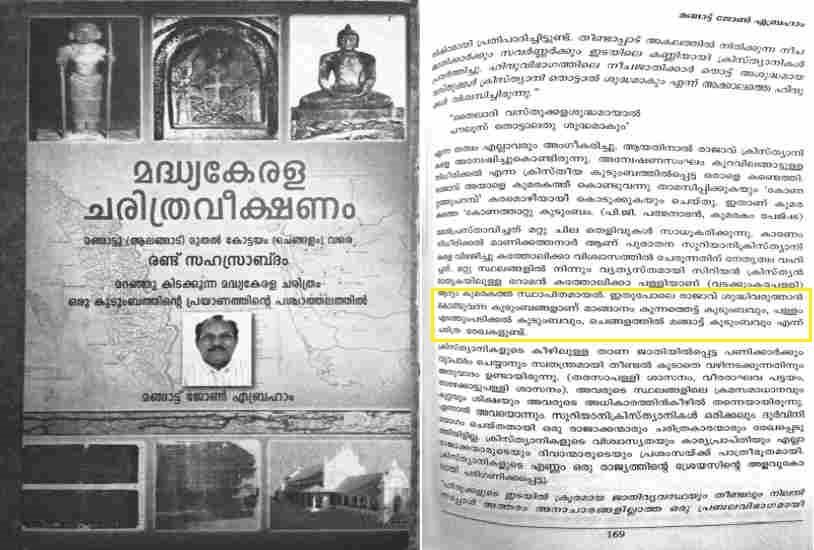
The book Madhya Kerala Charithra Veekshanam (മധ്യ കേരള ചരിത്ര വീക്ഷണം ) ,the author Mangattu John Abraham has written it in such a fashion that migration journey of a family, likely from the time it embraced christianity. The history of the geographical area between Mangadu and Kottayam, apparently the author's ancestoral family had gone through, has been narrated in a detailed way in this book. Author has put an appreciable effort to explain the social happenings and community life systems people had in the mentioned geographical area during that period. The social evils like untouchability, other religious and caste based ancient social systems also have been addressed in this book.
In page number 169 of the book, the Author observes that Christians have been instrumental as a link between Upper Caste and Lower Caste people. During that period Hindus believed that any substance which is believed to be turned impure by the touching of a lower caste member, the same can be turned back to purity if it is touched by a Christian. Hence the King of the time was looking for christians for the above mentioned purpose. Same page of the book remarks that Edathumpadickal family of Pallom and some other families for other places, were brought in by the King for the purifying purpose. (Courtesy to the author and publisher)
Establishment of Pallom St. Pauls Orthodox Church-Reference in the book 'Kandanad Grandhavari-Malankara Sabhacharithram' by H.G. Simon Mar Dionysius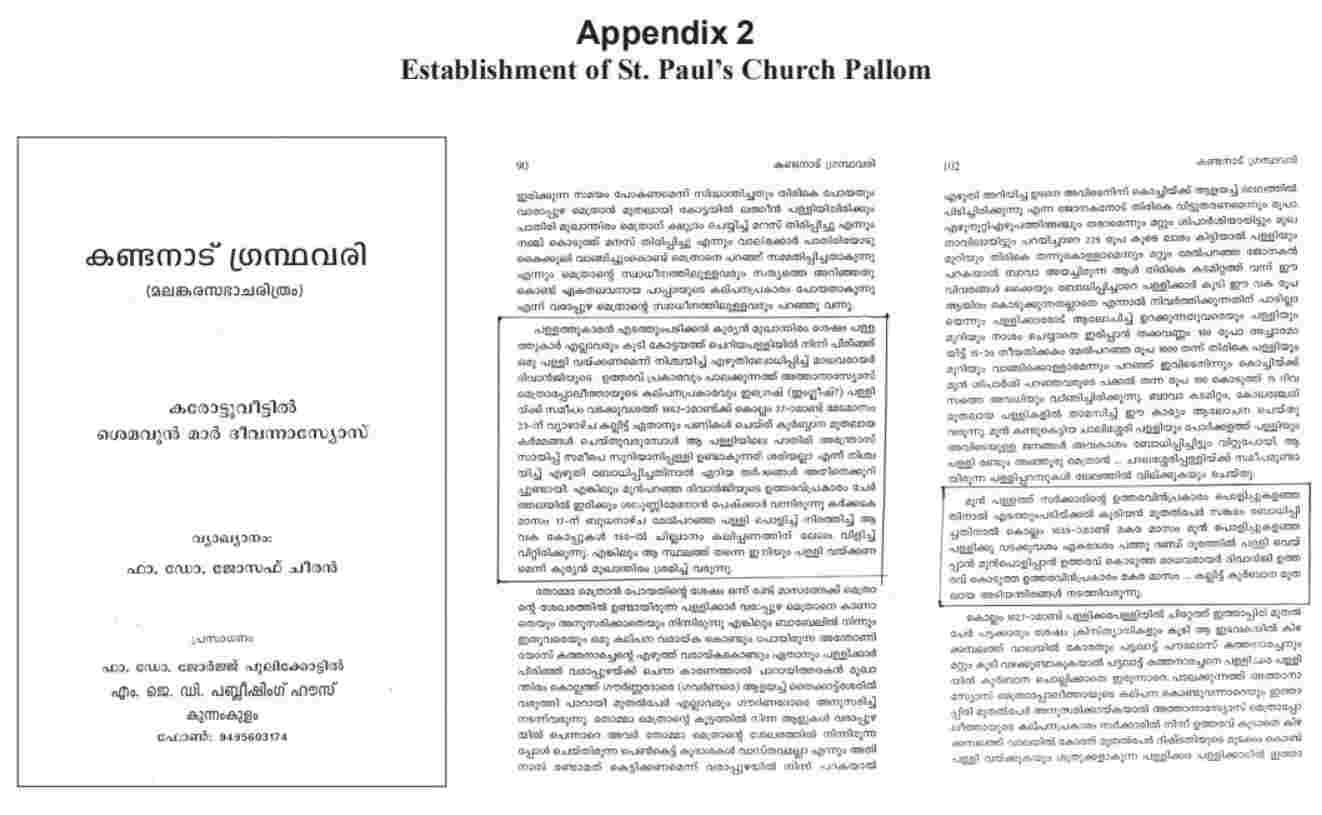
The Book Kandanad Grandhavari - Malankara Sabhacharithram (കണ്ടനാട് ഗ്രന്ഥാ വരി - മലങ്കര സഭാ ചരിത്രം) by H.G. Karottu Veettil Semavoon Mar Divannasyos(H.G. Simon Mar Dionysius) is considered as one of the most authentic history liturature about the Saint Thomas Christians in early 19th century. The original of the book is literally hand writen by the author and later the book was interpreted by Fr. Dr. Joseph Cheeran, who was the 1st rank holder in Malayalam Literature from Kerala University. The book is the most reliable one its category and a valuable one for students seeking for church history in 19th century, as the book is written as a commentary or day to day event basis by a witness. Kandanad was the ruling capital of Malankara Sabha in the AD1653-1815 period and that caused the name of the book Kandanad Grandhavari.
The first church built in Pallom area was near Karimpinkala Kadavu. In AD1837, the church was built by Edathumpadickal Vadakkekkuttu Kurian Itty Karyakkar on the land donated by himself. Kurian Itty had taken the help of the CMS missionary Rev. Henry Baker Sernior . Later, due to conflict between the Anglican and Syrian worship, Rev.Henry Baker Sr. took the charge by ousting Vicar Mammen Kathanar. The first Holy Baptism of Itty Kochitty, the son of Kurian Itty Karyakar was in the tradition of Anglican liturgy. This incident led to a decision to baptise the child again at Cheriapally, Kottayam, which created a rift between Rev.Henry Baker Sr. and Mr. Kurian Itty. This led to a split in the Edathumpadickal family and some members attended either the Kurichy Valiapally or Cheriapally Kottayam. A few members continued their membership at the Karimpinkalakadavu Church. This Church built in 1837 is the St. John the Baptist’s C.S.I Church, Pallom.
As the situations were as narrated above, Edathumpadicakl Pallikadavil Thomman Kurien, son of Kurian Itty continued the effort to establish a church with Syrian tradition. Under his leadership of him, a church was built at Pallikunnel property (presently the Central Stores of KSEB Office). Unfortunately, due to the influence of the missionaries with the state government, the church was demolished and shifted to another place. The indefatigable Edathumpadickal Pallikadavil Thomman Kurian took up the responsibility to construct a new church in 1865 AD, near Mundakathilkadavu. Under the able Vicarship of Eruthickal Kathanar and Venkadathu Kathanar, Holy Qurbana and other spiritual needs of the members were carried out peacefully from the church. This church is the present St. Paul’s Orthodox Syrian Church at Pallom.
In the pages 90 and 102 of the book, the author has explained the efforts of Edathumpadickal Kurian to establish a church with Syrian tradition in Pallom area. (Courtesy to the author and publisher)
The book 'Kerala Kristhava Charithra Directory' by Sri. Philip George
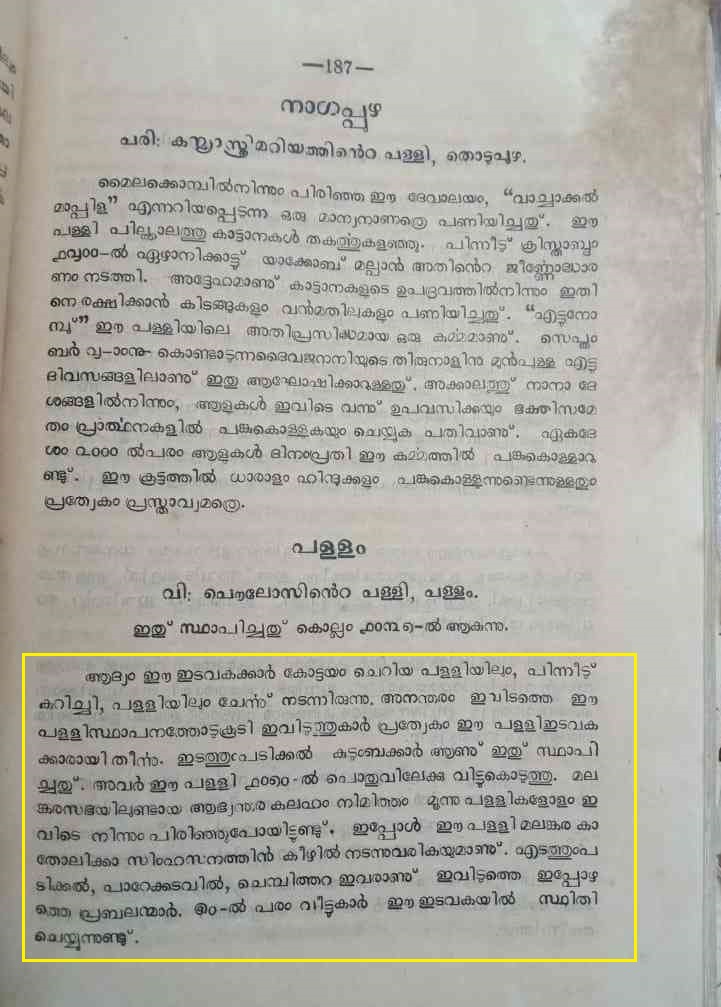
The book 'Kerala Kristhava Charithra Directory (കേരള ക്രൈസ്തവ ചരിത്ര ഡയറക്ടറി)' is published by M S Press, Changanassery in 1939. The book is a collection of facts and history related to the Saint Thomas Christians of Kerala. In the book, we can see the articles of Bishops from all church denominations stating their stands and beliefs. Author has done a very appreciable study on the history and facts before publishing the book. The book describes the history of many churches and its establishments all over in Kerala. In page number 187 of the book, it is mentioned about the establishement of the Saint Paul's Church at Pallom by Edathumpadickal family in Kollavarsham ൧൦൩൭(1037) and same was given to public access in Kollavarsham ൧൦൭൦(1070). (Courtesy to the author and publisher)
Mulanthuruthy Padiyola AD1876
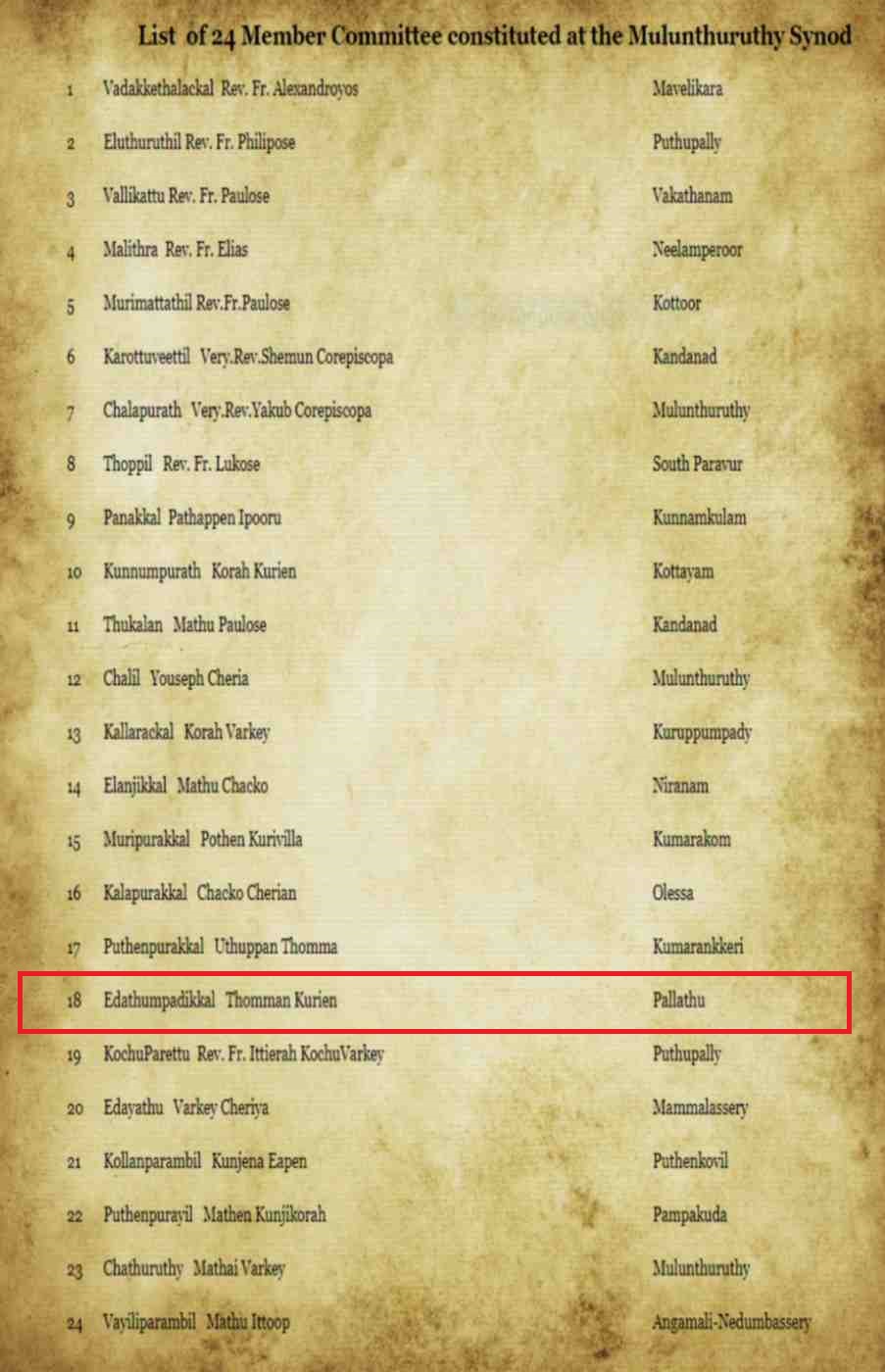
St.Thomas Christians had always embraced higher education and democratical thinking. Ofcourse, the education has caused lot of different opinions and healthy ideological arguments among the Church believers. The Mulanthuruthy Synod (മുളന്തുരുത്തി പടിയോല) was a result of such healthy arguments within the Church and later it caused the division of the Malankara Church in two fractions. The Synod of Mulanthuruthy happened in the 19th Century [15, 16, 17 of Midhunam 1051 M.E. (28th, 29th & 30th June, 1876)]. The synod represents the inauguration of an official relationship of a section of the Malankara Church with the Patriarch of the West Syrian Church. This Synod was called and presided over by Patriarch Peter IV of the West Syrian Church. 103 churches of the Malankara Church represented there.
The reason of stating the Mulanthuruthy Synod here is, even though it caused a division in the Church, it is a historically important incident. Out of the 103 Churches that participated in the Mulanthuruhi Synod, one was Pallom and Sri. Thomman Kurien Edathumpadickal was the person represented Pallom. Sri. Thomman Kurien was in the 24 Member Committee of Mulanthuruthy Synod.
Malankara Church and St. Thomas Christians have gone through many divisions and they are following different liturgies and traditions. Our family members are now in various churches such as Orthodox, Jacobite, CSI and Marthoma etc. Even when facts are as narrated above, by the Grace of Almighty God,the affection and love among the family members remains unchanged.
Clicke here to see more details of the Mulanthuruthy Padiyola and its 24 Committee List
The Kerala Council for Historical Research (KCHR)

The Kerala Council for Historical Research (KCHR) is an autonomous research institution committed to excellence in research in History , Archaeology and other areas of Social Science and is recognized as an official research centre of the University of Kerala and funded by the Ministry of Higher Education, Government of Kerala. Research, publication, documentation, training and co-ordination are the major domains of KCHR. KCHR is involved in high-profile projects such as Digitizing Kerala's Past, Post Excavation works of the Pattanam Archaeological Research (2007 - 2015 ) , Charitra-Anweshana Yatrathakal, Archives on Malayali Family Histories and Biographies, Oral History Project, Panchayath Vijnaneeyams, History of Malayali Migrations and Migrant Communities, Biographical Documentation of Kerala Women etc. Click here to see the list of Family History Documents found in the archives of KCHR
In the KCHR website(the site in under re designing stage and not active at the moment), the Archives page gives the list of Family history books that are available in its archives. Out of 230 recorded family histories selected from all over Kerala State that are matching with historical facts and reliable record evidences, one is the History of Edathumpadickal Family and that is the most oldest.
The Synod of Diamper ( Udayamperoor Sunnahados ) in AD1599
 The Synod of Diamper (ഉദയം പേരൂര് സുന്ന ഹദോസ്) , held at Udayamperoor, was a diocesan synod, that created rules and regulations for the ancient Saint Thomas Christians of the Malabar Coast, modern Kerala state, formally uniting them with the Catholic Church. The Synod of Diamper was convened on June 20, 1599, under the leadership of Aleixo de Menezes, Latin rite Archbishop of Goa. The then Archdeacon of Saint Thomas Christian Gheevarghese of Cross, was forced to comply with the wishes of the Archbishop of Goa.
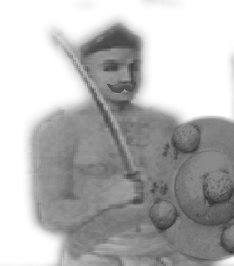
Our first known ancestor Mathoo Chakkarayakathoottu was the Akambady Nayakan(Captain of the Guard)of Alangad Raja(King) in the last decade of 16th Century. As there were threats from Portugese, Akambady Nayakan Mathoo was deputed by the Alangattu Raja to take care of the security of the Archdeacon Gheevarghese of Malankara Nazrani Christians for attending the Udayamperoor Synod, at the behest of the Roman Catholic Arch Bishop Alexio De Menezes of Goa and Viceroy of Portugal.
Click here to see Wikipedia mentions about the above matter in its page for Alangad
Click here to see Wikipedia mentions about our ancestor Maathu who was Akambady Nayakan of Alangad Raja, in its page for Akapparambu
Edathumpadickal is the first Syrian Christian family settled in Pallom
Pallom was one of the province(kara) of Nattakam from the Munjunadu Dynasty time and later Thekkumkur Dynasty conquerred it and annexed the area to Thekkumkur Kingdom. Thekkumkur dynasty built a royal palace in Pallom in 14th Century called Edathil Palace. Our ancestor Ittymathoo(4th Generation) shifted to Pallom from Kottayam accepting the invitation of Edathil Thampuran, in AD1865.
Edathil Thampuran gifted tax free agricultural land and built a house for Ittymaathoo at the land infront of Edathil Palace. From then, the house started to be known as 'Edathin Padickal(എടത്തിന് പടിക്കല്)' and later became to known as "Edathumpadickal (എടത്തും പടിക്കല് or ഇടത്തും പടിക്കല്)".
Click here to see Bharatpedia mentions about the above matter in its page for Pallom
The family tree prepared by our ancestors almost a century ago

The first family meet of the Edathumpadickal family was held in the year 1936. The family tree was prepared in the same year by the then committee members Sri. P.K. Mamman Pallickal, Sri. Chandy Itty Vadakeparampil, Sri. P.C. Joseph Meledom(First Native Principal of CMS College-Kottayam) and Sri. Mr. V.K. Itty Poovathummottil. The Edathumpadickal family members are indebted to the above mentioned members for their effort in collecting genealogy details from each branches and researching the history for our Genealogy Book which is published first in 1939.
Kallooparamban Chunadan Vallam(Kerala Snake Boat)-കല്ലൂപ്പറമ്പന് ചുണ്ടന്
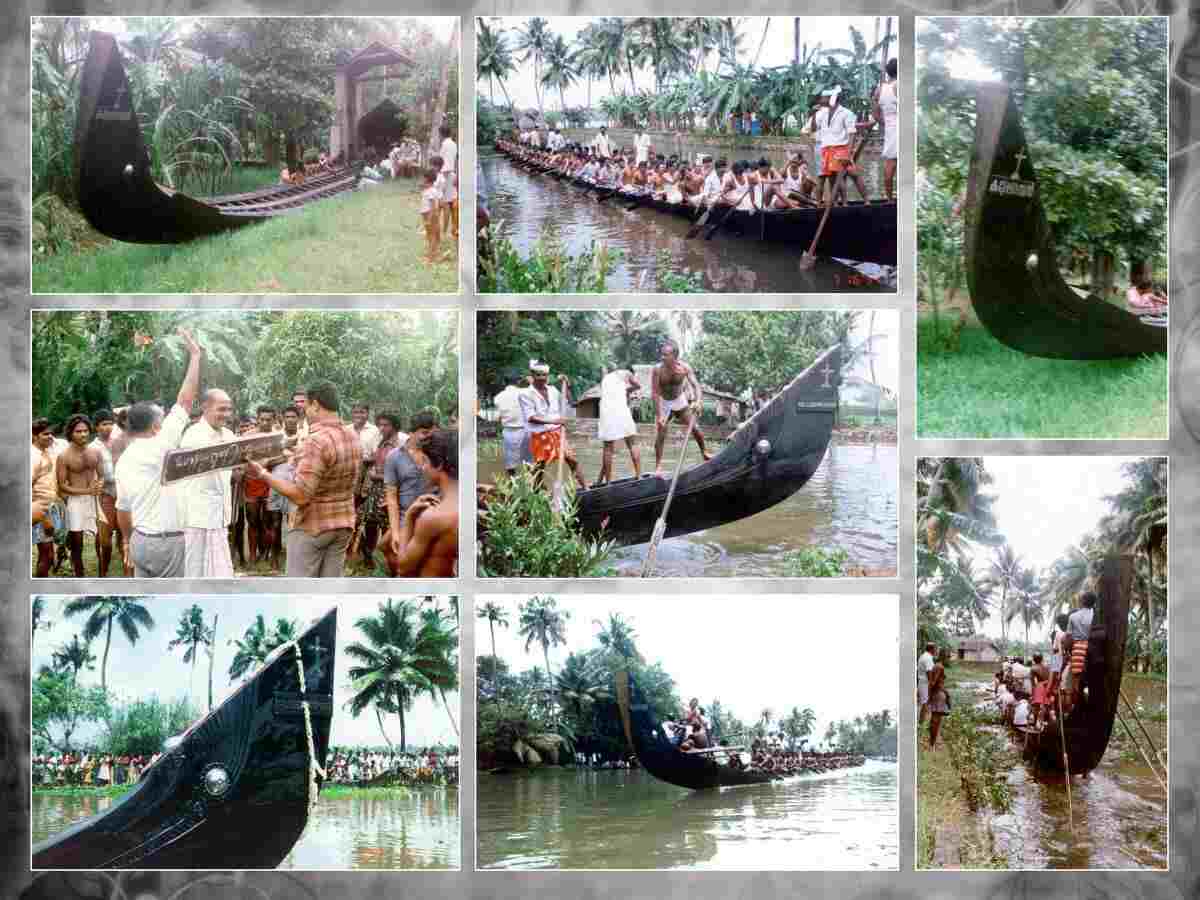
Kerala is the land of Rivers, Lakes, Canals, Backwaters, agriculture and fishing. The Vallam Kali is a traditional kind of boat race in Kerala that has got history and traditions from AD 1545. It is a form of canoe racing, and uses paddled war canoes. It is mainly conducted during the season of the harvest festival Onam in autumn and ofcourse a major attraction for tourists worldwide. The canoes (traditional wooden boats) are of different types such as chundan vallam(ചുണ്ടന്), churulan vallam(ചുരുളന്), iruttukuthy vallam(ഇരുട്ടുകുത്തി), odi vallam(ഓടി), veppu vallam(വെപ്പ്), vadakkanody vallam(വടക്കനോടി) and kochu vallam(കൊച്ചു വള്ളം). The major event of every Kerala boat race is the Chundan Vallam(Kerala Snake Boat) race, which are vary from 100 to 138 feet in length. The Nehru Trophy Boat Race is a popular vallam kali event held in the Punnamada Lake near Alappuzha, Kerala, India.
In Alappuzha and Kottayam Districts of Kerala, different areas(Kara/Kari) have got their own Chundan Vallams and every year they competite in various Boat races conducted all over in Kerala. Nehru Trophy is the most popular and prestigious race to win by each Chundan Vallam from different areas. Very few number of families in Kerala State have got their own Chundan vallams.
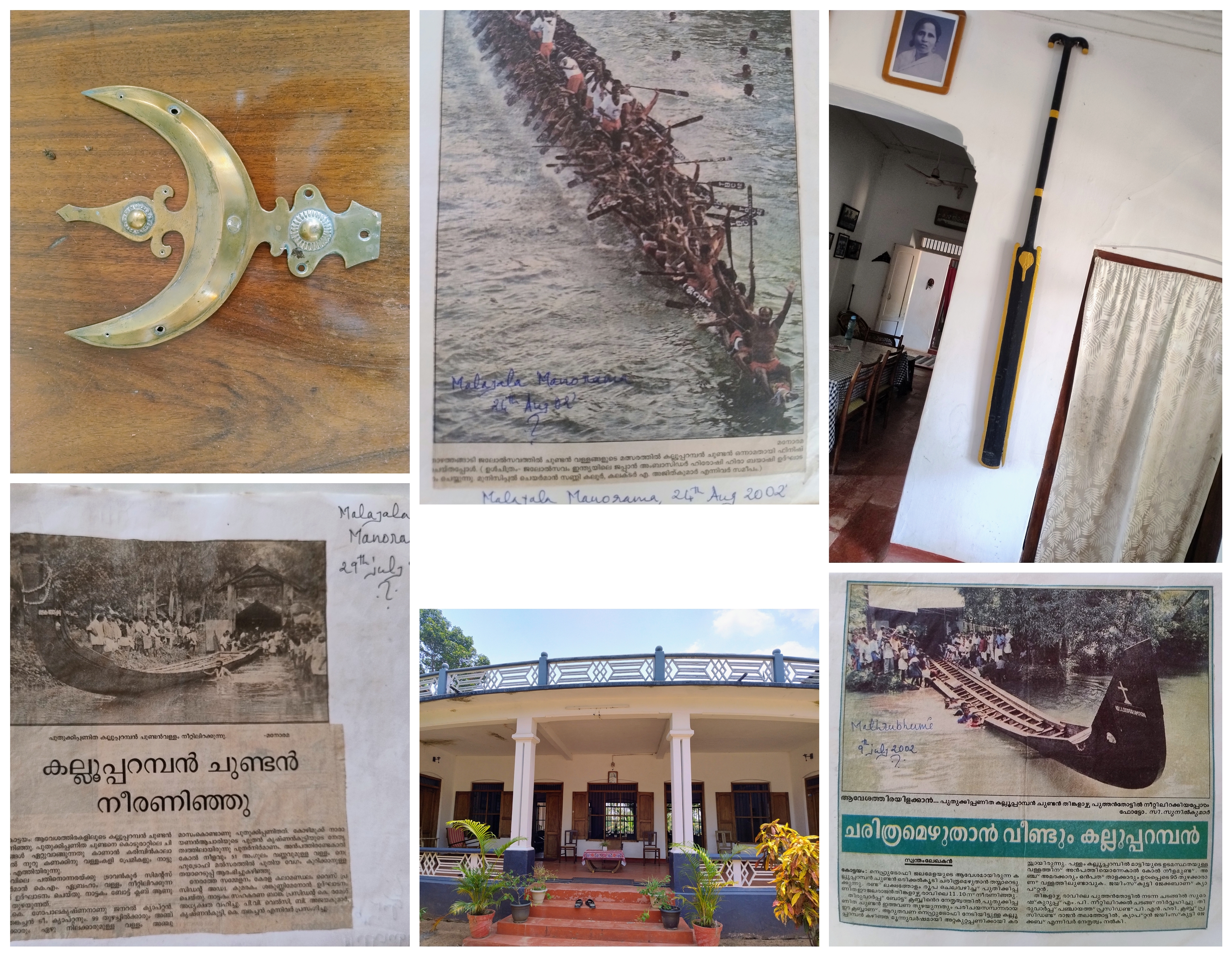
Kallooparamban Chundan vallam(കല്ലൂപ്പറമ്പന് ചുണ്ടന് വള്ളം) is owned by Sri. Halley Mathew - Kallooparambil House of Edathumpadickal family. Kallooparamban Chundan has won the prestigious Nehru trophy six times(in the years 1970, 1971, 1972, 1973, 1992 and 1993) and it is a personal pride to all our family members. Sri. Halley had 2 other iruttukuthy vallams(boats) named as Matty(മാട്ടി) and Azhakeshan (അഴകേശന്).
Click here to see the Official Website of Nehru Trphy Boat Race Click here to see the complete history of Kallooparamban Chundan and two iruttukuthi boats owned by Sri. Halley Mathew - Kallooparambil House of Edathumpadickal family(External Blog)